White Space Is Doing the Work
· 7 min read
The fastest way to make a good photo look cheap is to crowd it.
Not to print it small. To crowd it. A photograph that would stop you on its own page turns into filler when five neighbors press against it, because the eye stops settling and starts scanning — and scanning is a screen habit, the exact one a printed book exists to interrupt.
So before asking how many photos fit on a page, ask what the empty part of the page is for.
The urge to fill
The urge comes honestly. The pile holds thousands of photos and the book will hold eighty, so every blank stretch of paper looks like a photo that didn’t make it. People fill pages the way they pack suitcases, pressing one more thing into every corner, out of a feeling that room left over is memory left behind.
There’s a cost argument hiding in there too. Pages cost money, so a page should earn its keep, and a full page looks like it’s working harder than a half-empty one. But a page earns its keep by being looked at, not by carrying the most.
And underneath both is a quieter worry: that the photos left off the page are somehow lost. They aren’t. The camera roll keeps every one of them, and always did. The book has a different job: letting a few of them speak clearly.
Galleries have understood this for a century. A museum could hang forty paintings in one room. It hangs nine. The empty wall is doing a job: it tells you where to look, and that the painting deserved the room. Nobody leaves a gallery complaining about all the art that could have fit in the gaps.
A book is a gallery you can hold. The same rules apply at reading distance.
What a margin says
Print a wedding invitation edge to edge and it becomes a flyer. Same paper, same words. The margin was the difference.
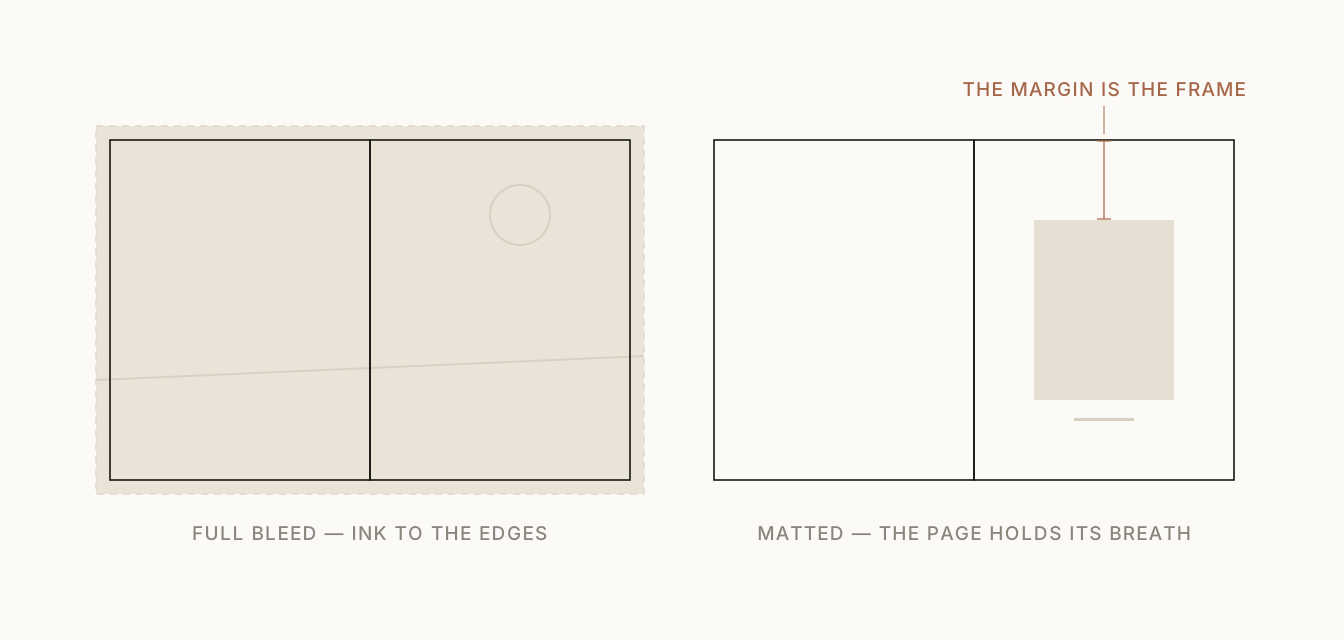
Around a photo, that band of quiet paper does two jobs at once. It protects the image, keeping it clear of the trim and of the photo across the gutter. And it frames it, the way a mat frames a print on a wall, which is why a matted photo reads as chosen and a wedged-in photo reads as stored.
Nobody needs this explained to feel it. Hand someone the same page laid out twice, packed and matted, and ask which book costs more. They’ll pick the margins every time and struggle to say why.
There’s a related move worth stealing: shrink the photo, grow the mat. The smallest photo on the widest field of paper reads as the most important object in the book. Jewelers figured this out long ago. One ring, one tray.
This is why margins and mats are hard rules in the pages Enchanta composes — a spread can carry one photo or six, but no photo count is allowed to eat the frame.
Full bleed or matted
One page decision changes a photo’s register more than any other: whether the ink runs to the edge.
Full bleed means the photo runs off all four sides. No border, no pause between the image and the world. Held open, a full-bleed spread leaves no edge to remind you it’s paper; the page disappears and the place takes over. A beach at low tide, a city from a rooftop at dusk. Photos with scale and atmosphere get that scale back when they’re allowed to swallow the page.
A matted photo does the opposite. The page stays present, the photo becomes an object resting on it, and the reader shifts from standing in the scene to holding a record of it. Smaller, yes. Also more deliberate. Someone chose this and set it down here.
Both registers are right at different moments, and one practical difference matters as much as the mood. Full bleed crops: the printer trims through the photo’s edges, so a hand near the border or the top of a head can be lost to the blade. A mat keeps the whole frame. When a photo’s edges carry information, the kind choice is the mat.
There’s also an economy to respect. Full bleed spends drama. Spend it on every spread and the book arrives at its best photo with nothing left in the account.
When six is right
None of this means a page can never be full. Some moments arrive as commotion, and a page of small frames is the only honest way to print them.
A water fight. A kitchen at holiday capacity. The last chaotic hour of packing the car. Set six frames on the spread, each about the size of a postcard, and they read together as one event: the page turns into motion, almost into footage.
What a dense page costs is attention. Nothing on it gets looked at for longer than a second or two, and each photo gives up its individual claim in favor of the group’s. That’s the trade, and it’s worth making exactly when the photos are beats of the same moment. Six frames of the water fight make a page of pure energy. Six unrelated moments in the same grid make an index, and nobody lingers on an index.
So the question for a crowded page is never whether the photos fit. Photos always fit; that’s what smaller means. The question is whether they belong to one another.
The lake morning at three densities
Take the last morning of a lake summer. Thirty-one photos of it survived the first cut: the jump off the dock, the dog in the shallows, waffles, wet footprints on the boards, towels heaped on a chair, the light on the water at seven.
Built as one photo, the spread is the wide shot: lake flat as glass, one kid mid-air off the dock, given the whole field with a single line of text or none. The morning becomes an image. It’s the version you can picture as the cover.
Built as three, the wide shot keeps the left page and two details share the right: the footprints, the towels. Establishing plus texture. The morning becomes a scene you can almost walk through.
Built as six, everything is small and quick: the jump, the splash, the dog mid-shake, the waffle negotiations, the sunscreen protest, the hammock. The morning becomes a commotion. Which may be exactly what it was.
None of the three is wrong, and the arithmetic barely notices: one spread absorbed one, three, or six of the thirty-one. What changes is what a reader takes away: an image, a scene, or the noise of a family in July. Choose by what the morning actually was, not by how many photos are waiting for seats.
Then turn the page in your head, because whatever density this spread got, the next one probably shouldn’t repeat it.
Loud pages need quiet ones
The last thing photo count decides is pacing.
A book where every spread holds one photo is wall-to-wall solemnity; it whispers so steadily the whisper stops registering. A book where every spread holds six is an archive with a cover. Neither feels edited. Editing shows up in the alternation: crowded then still, a burst of small frames and then one photo with room enough to hold the eye.
Quiet pages are what give loud pages their volume. The six-up water fight lands hardest right after a spread that held almost nothing, the same way a shout lands hardest in a quiet room. If the whole book shouts, nothing in it does.
This settles the worry about consistency, too. Alternating dense and sparse pages is rhythm, not indecision. Rhythm is most of what people mean when they say a book flows.
The part you didn’t fill
A finished book never gets complimented on its margins. People say it feels calm, or considered, or that it looks like it was made with care, and they can’t point at why.
The why is the space. The margin around the photo of your grandmother is the page saying she mattered. The near-empty spread after the wedding chapter is where the reader exhales. The room you left is doing something no additional photo could have done in its place.
White space is not what’s left over when the photos run out. It’s where the reader stands.
Questions people ask
- How many photos per page is right for a photo book?
- Think in spreads, the two pages you see at once. One to six photos per spread is the workable range, and an average around three keeps a book readable. On a single page that usually means one or two, with denser pages saved for moments that were genuinely chaotic.
- Is white space in a photo book wasted space?
- No. The margin is what tells the reader a photo matters, the same way a gallery leaves wall around a painting. A crowded page gets scanned; a photo with room around it gets looked at.
- Should photos be full bleed or have borders?
- Mostly borders, with full bleed saved for the few photos that earn it. Ink to the edge is immersive and suits images with scale and atmosphere, but the trim cuts into the photo's edges, and the drama fades if every page uses it. A matted photo keeps its whole frame and reads as chosen.
- Can I mix busy pages and quiet pages in one book?
- You should. Uniform density is what makes a book feel monotonous, whether it's all quiet or all crowded. A dense spread followed by a still one is pacing, and pacing is most of what makes a book feel edited.
- Does every photo deserve its own page?
- No. A photo alone on a page is a claim of importance, and a book where every page makes that claim has no way left to emphasize anything. Save the full pages for the photos that carry the story's weight.