The Anatomy of a Photo Book
· 7 min read
A good photo book has bones.
You can feel them even when you can’t see them. Pick up a book someone built with care and it opens like a story: the outside promises, the front welcomes, the middle has rooms, the end closes a door. Pick up a stack of printed pages, photos placed in order until the photos ran out, and you can feel that too. Usually by page six.
The difference is anatomy. A book is made of parts, each with a job, and most of them go unnoticed precisely because they’re working. Readers feel these parts without knowing their names. Makers skip them for the same reason. So here are the names. Once you have them, a pile of pages starts behaving like a designed object, because you can finally see what’s missing from yours.
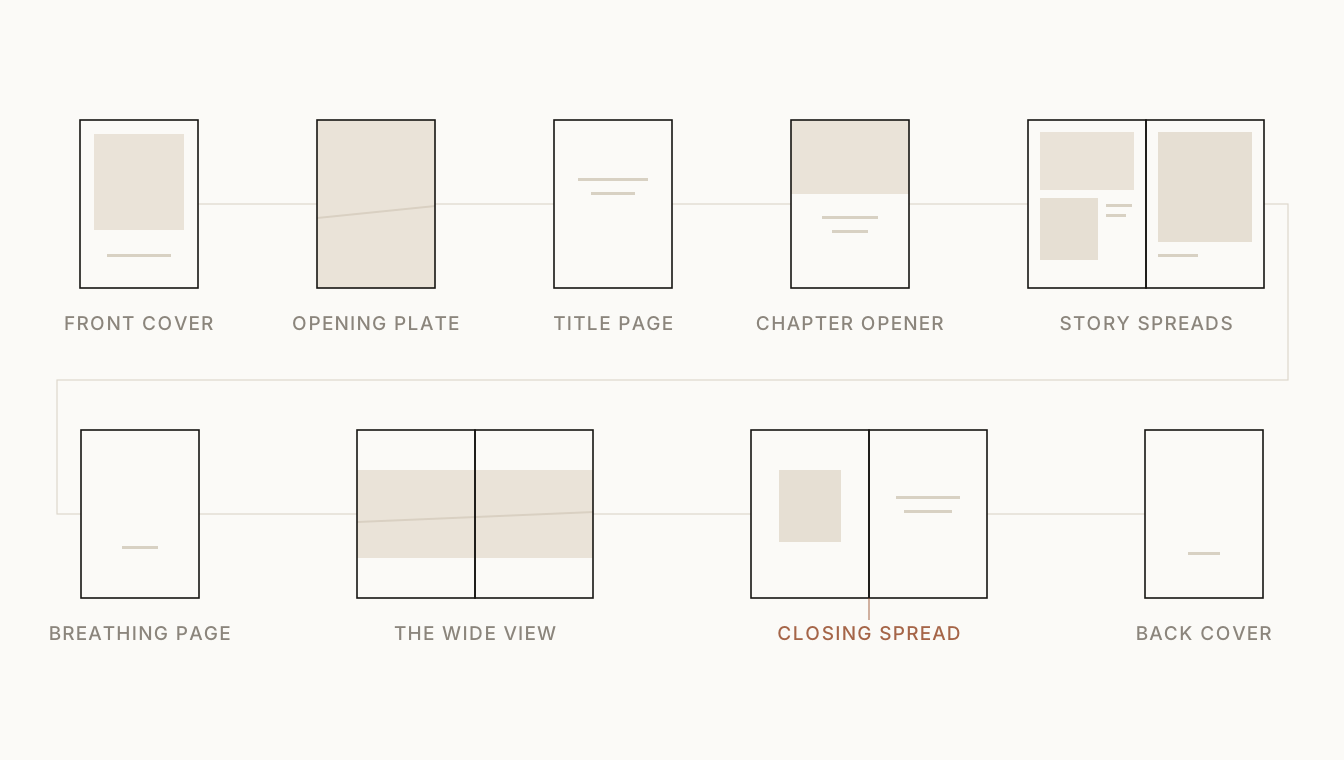
Walk it front to back.
The outside makes a promise
The cover is the one part everyone already takes seriously, so it needs the least persuading. One photograph and a few words, and it will be looked at more than any page inside: every shelf pass, every guest who picks it up. Its job is not to summarize. It’s to promise: this is what kind of book you’re holding. The choice it demands is discipline. One subject or the whole cast? The place or a face? Pick one thing and let it be the promise. Covers fail by trying to be the whole book at once.
The wrap is the cover’s hidden test. On a hardcover the photograph folds around the spine and continues across the back, so the image has to survive being creased in two places. A face near the fold takes the crease badly. A horizon takes it in stride. Before committing to a wrap photo, look at its full width and find the two folds.
Then the spine, the sliver that does the longest service. On a shelf, the spine is the book. A readable title and a year will matter more in ten years than almost any decision inside, and if a second book might follow someday, keep the spine simple enough to repeat.
Endpapers, the sheets lining the inside of the cover, only need to be a color that doesn’t argue with anything. That’s the whole job. Onward.
The book clears its throat
Most books rush the opening.
A book shouldn’t start at full volume. Between the cover and the story there’s a threshold, and crossing it takes a page or two. The old name for it is the plate: a single image printed before anything is explained. In a photo book, the opening plate is one photograph standing alone on the first page, or a quiet gathering of small moments there. Its job is register. It tells you how the book will speak, hushed or bright, close or wide, before it says a word.
Choosing it is a small art of its own, because the right candidate is rarely the best photo. The best photo belongs inside the story, at the moment that earns it. The plate wants the most atmospheric one, the photo that smells like the whole trip. Light through a kitchen window. Whoever the book is about, mid-laugh, slightly blurred, unmistakably themselves. This is why Enchanta opens the books it composes with a gathered plate: small moments on the first page, a threshold before the story starts.
The title page is plainer. The book states its name and its span, and maybe allows itself one more line. “Summer, 2025.” “The year we moved.” The choice is how much voice the name carries: a date locates the book; a phrase remembers it. You’ll say the title out loud more often than you’d guess (“get the yellow-house book down”), so give it a name a person would actually say.
Together, the plate and the title page cost two pages. They’re the difference between walking into a story and being shoved into one.
Rooms, not a corridor
The middle holds nearly all the photos, and the common mistake is to build it as one long hallway. Photo after photo in strict order, no walls, no doors. Sixty pages of that will flatten even good photographs, the way a museum with no rooms would flatten the paintings.
Chapters are the rooms. A chapter is nothing more than a stretch of pages that belong together: a leg of the trip, a season, one person, a single day big enough to deserve walls. Chapters exist for orientation and rhythm. The reader always knows where they are, and the book gets clean places to change subject instead of drifting. The maker’s choice is the cutting unit — days, places, months, people — and the honest answer is whichever one the photos already cluster around.
Every room needs a door. The chapter opener is a page that announces the change: a title, one photograph, air. Not the chapter’s best moment, which would spend the climax at the doorway. An establishing image. The view from the new city, or the front of the grandparents’ house. One page of pause, so the previous chapter can finish echoing.
Run the arithmetic once on a real book and structure stops looking like overhead. Take a 48-page book of a family summer, cut into four chapters. Opening plate, one page. Title page, one. Four chapter openers, four. A few breathing pages, three. One photograph given a full spread, two. The closing spread, two more. That’s thirteen of the forty-eight pages doing something other than delivering the next photo, roughly a quarter of the book, and the thirty-five that remain carry the story comfortably: about ninety photographs. The alternative is a hundred and twenty photos in a corridor, and a reader who flips faster with every page.
Structure is what stops the flipping.
Quiet, on purpose
Three parts of the middle work by holding back. They’re also the first ones beginners cut.
The breathing page holds one photograph, small, in a field of white. Sometimes it holds nothing but a line of text. It looks like waste; it’s volume control. Pages only read as loud or quiet next to their neighbors, so a dense, lively spread needs stillness nearby to stay lively instead of merely crowded. Put a breathing page right after the biggest scene in a chapter and the scene grows. The choice here is resisting the guilt: an almost-empty page in a book you’re paying to print feels indulgent, right up until you hold the finished thing.
Captions are the book speaking, small. Their job is whatever the photograph can’t say on its own: names, places, dates, the sentence someone actually said. The choice is one voice, kept — warm, plain, funny, documentary, whichever — from the first caption to the last, because a book that switches registers reads like a group chat. And most pages want no caption at all. Silence is a caption too.
The wide view is one photograph across a full spread, edge to edge. The book’s deep breath. For two pages the pace stops entirely and a single image takes the whole field. Almost any book can afford one or two of these; none can afford six. The photo has to be big enough to hold it: a landscape, a small figure in a large place, the whole table mid-meal. And mind the fold in the middle: a face in the gutter is a face folded in half.
The ending is a decision
The last spread is the most neglected part of the anatomy, and after the cover, the most important.
An unbuilt book doesn’t end. Its photos simply run out, and the final page is whatever happened to come last: a half-filled grid, an airport, someone’s shoe. All the care upstream evaporates in that shrug. A reader finishes a book holding its last image. When the last image is an accident, the book’s final word is an accident.
A built ending takes one of a few shapes. One wide, quiet image that lets the book exhale: the beach at dusk after everyone has gone in. Or the cast gathered, the closest thing you have to everyone together, looking back at the reader. Or almost nothing: a single line of text on an otherwise empty page. “We drove home on the first of September.” Any of the three works. What they share is intent. Someone decided that this is where it ends, and a reader can feel the decision the same way they can feel its absence.
The choice at the ending is the truest one in the book: not which photo is best, but what the book was about. Endings are where that gets admitted. A trip book that was secretly about your father ends on your father. A summer book that was secretly about the house ends on the house, empty and lit. Choose the last image the way you’d choose a last sentence. Then let it stand.
Done well, something small happens to the reader. They close the back cover and sit for a second, the way people sit when a film ends. Nothing queued next, no feed underneath. Just the weight of the thing in their hands.
The photos ran out. The book didn’t.
Questions people ask
- Does every photo book need chapters?
- Short books don't. Under thirty pages or so, one continuous run of pages reads fine, especially for a single event like a weekend or a party. Past that, chapters earn their keep: the reader always knows where they are, and the book gets clean places to change subject or season.
- What goes on the first page of a photo book?
- Not the first photo of the story. Open with a threshold: one atmospheric photograph standing alone (an opening plate), or a simple title page with the book's name and dates. The story starts a spread later, and lands better for the pause.
- What is a breathing page?
- A page that holds one small photograph in a lot of white space, or no photograph at all. It isn't wasted paper; it's pacing. Busy spreads only read as lively when something quiet sits nearby, so a breathing page placed after a big scene makes the scene feel bigger.
- How should a photo book end?
- On purpose. The three reliable shapes are one wide quiet image, a gathering of the people the book was about, or a single line of text on an almost-empty page. What matters is that the final spread is chosen, not just whichever photo happened to come last.
- Where do captions belong in a photo book?
- Close to the photographs they serve, set small, in one voice kept from cover to cover. Many pages need none at all. Save the words for what the photo can't say: names, places, dates, or what was said just out of frame.